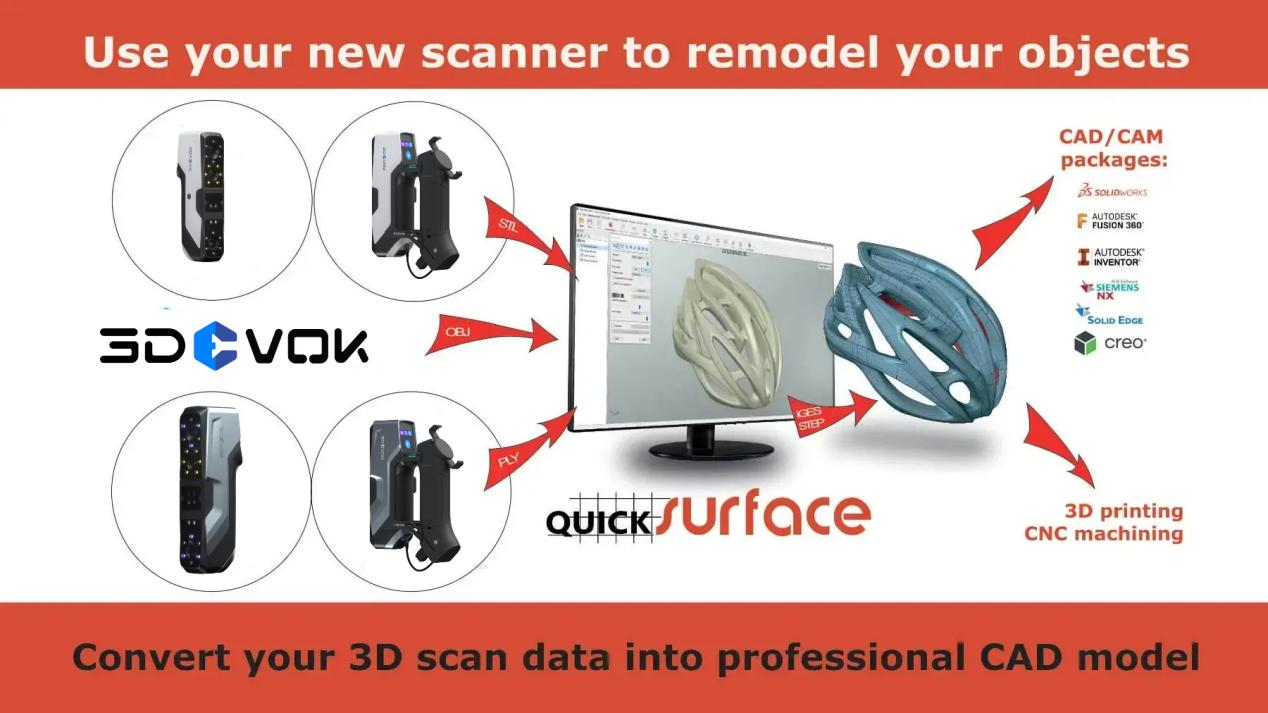
3D reverse engineering software is a type of digital tool that can take the surface geometry of a physical object that has been scanned in 3D and turn it into a fully editable and usable mathematical model. The main reason this technology is needed is because of a basic incompatibility: When you use a 3D scanner, it makes a point cloud or polygon mesh, which is a huge collection of coordinate data that shows the surface as a still picture. But when you use CAD files for industrial and engineering purposes, they use lines, arcs, planes, and splines to define geometry. The 3D scan reverse engineering software’s job is to be the smart translator that turns the inactive geometric mesh into a CAD model that is ready for changes, simulations, and production. This digital conversion is very important in many fields. QUICKSURFACE, one of the best solutions, is designed to work perfectly with high-accuracy scanners from 3DeVOK. It has the hybrid modeling tools needed to do this difficult job quickly and easily.
Why conversion is important: raw scan data vs. design intent
The main reason why dedicated 3D reverse engineering software is thought to be the best is that it can get “design intent” from the surface it captures. No matter how accurate a scanner is, it only shows what it sees, such as flaws in the manufacturing process, noise on the surface, and wear. So, a raw mesh is not the exact mathematical definition needed to make blueprints or set CNC toolpaths; it is just an approximation of the original design. For example, a hole on a scanned mesh might look a little oval or rough because of small flaws in the material or the scanning process, but the design goal was a perfect cylinder.
A regular CAD program can’t just follow this mesh because it’s not perfect. 3D reverse engineering software gets around this problem by using advanced fitting algorithms. The engineer can choose the mesh data that goes with the imperfect hole, and the software quickly calculates and fits a perfect, mathematically correct cylinder in its place. This process rebuilds the desired shape by getting rid of the noise of the real world and replacing it with the clean, logical structure that engineers need. These specialized platforms are different from generic modeling tools because they can intelligently interpret raw data. This makes sure that the resulting digital file is not only accurate but also ready for use in industry.
The main method is hybrid modeling and extracting geometric features.
The best 3D reverse engineering software uses a method called hybrid modeling, which can handle both mechanical, feature-driven parts and complex, free-form organic shapes. The software focuses on Geometric Feature Extraction for mechanical parts that have planes, slots, holes, and bosses. The engineer uses the software to sketch and cross-section directly on the mesh data. For instance, an engineer can use QUICKSURFACE to set up a 2D sketch plane based on the scanned part, project a cross-section of the mesh onto that plane, and then use automatic fitting tools to trace and turn the projected data into perfect lines, arcs, and splines. Then, these 2D sketches are extruded or revolved to make the 3D features again, making sure they meet strict engineering standards.
For organic or aesthetic components like sculptures, anatomical forms, or automotive bodywork, the software employs Free-Form Surfacing to generate smooth NURBS surfaces that conform to the mesh’s complex contours. While largely automated, this process allows precise control over curve fitting and tension.
Integral to all professional platforms are Deviation Analysis tools, which generate color-coded maps to visually compare newly created CAD surfaces against the original scan data. This immediate feedback confirms whether reconstructed components maintain required dimensional tolerances, ensuring accuracy throughout the reverse engineering workflow.
The 3DeVOK Seamless Workflow and QUICKSURFACE
QUICKSURFACE is the best 3D reverse engineering software because its developers focused on making it easy to use for scan data. It avoids the problems that come with traditional CAD systems by offering a simple, feature-rich space that is optimized for quick mesh manipulation and sketch-based reconstruction. This design philosophy cuts down on the time it takes to rebuild a model by a lot, which has always been the slowest part of the reverse engineering process. The program can import large amounts of data from high-speed scanners and has all the tools needed for preparation, like mesh optimization, alignment, and trimming, before the reconstruction process even starts.
The overall solution is strong because it works well with the capture hardware. 3DeVOK‘s high-accuracy scanners make sure that the data sent to QUICKSURFACE is already clean and accurate, so the software doesn’t have to fix big mistakes as often. This synergy lets engineers go straight from scanning to CAD reconstruction, taking advantage of QUICKSURFACE’s wide range of Universal Export Formats, such as STEP and IGES. This makes sure that the final editable model works with any major manufacturing or analysis platform around the world. In the end, 3D reverse engineering software is not just an extra tool; it is the only tool that can turn useless digital measurements into useful, valuable, and changeable engineering assets. This makes the 3DeVOK and QUICKSURFACE solution a very effective choice for professional digital manufacturing workflows.
