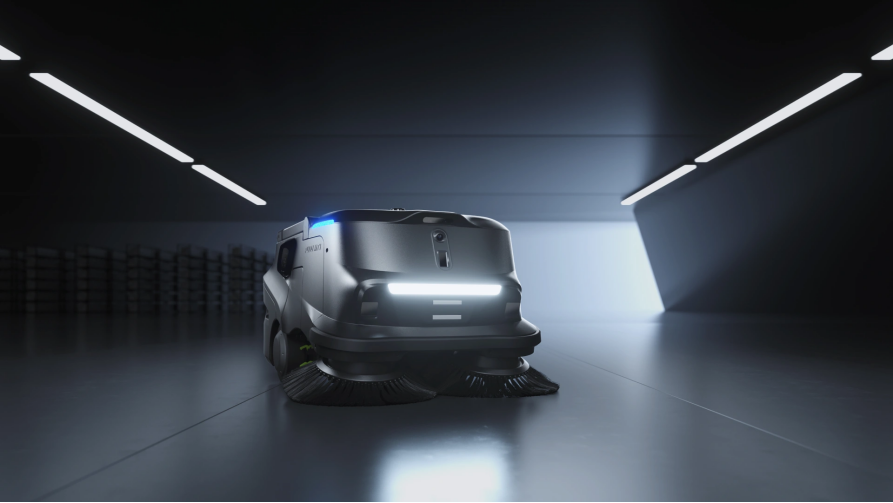
Why recycling-line operators are now treating 24/7 autonomous sweeping as a hygiene and labor decision, with a Japanese recycling facility’s MT1 deployment as the operational reference.
May 26, 2026 | About 10 minutes read
Recycling and waste-processing facilities are not where most readers picture an autonomous mobile robot. The work is heavy, the environment is dusty, the floor accumulates debris by the hour, and the people who run those plants have spent careers solving operational problems that the rest of industry never sees. Floor cleaning sits at the bottom of the org chart and at the top of the daily friction list.
That is the operational context for a recent deployment at a Japanese recycling and waste-processing operator. The facility brought a new recycling line online in April 2026 and, alongside the line itself, deployed a Pudu Robotics MT1 industrial autonomous sweeper to handle 24/7 floor cleaning across the recycling-line area. The headline operational pattern is not unit count or robot speed. It is a hygiene-baseline shift: a recycling-line floor that resets itself continuously instead of accumulating dust and debris between scheduled cleaning shifts.
Two outcomes show up immediately in the deployment data, and both translate to procurement language that a recycling-facility manager can defend in front of operations, safety, and finance at the same meeting. Dust and debris are collected continuously throughout the day. Operators are freed from the most repetitive cleaning duty they carry, and redeployed to higher-value process work along the line.
Why recycling and waste-processing facilities are quietly entering the cleaning-robot conversation
Two pressures are reshaping how recycling and waste-processing facilities think about floor cleaning. First, the operational hygiene bar keeps rising. Regulators, OEM customers (for recycled materials), and ESG reporting frameworks all push facility managers toward documented, consistent housekeeping rather than scheduled cleaning shifts. Industry data from the International Solid Waste Association (ISWA) and the Japan Ministry of the Environment shows a continued expansion of recycling-line throughput, with more material crossing the floor per shift and a stricter expectation that the floor stays clean while it does.
Second, the labor side is no longer absorbing the gap. The International Federation of Robotics’ 2024 World Robotics report documents continued growth in professional service robots, including autonomous floor-cleaning units, across industrial and facility-management applications. Japan in particular has been ahead of the curve on labor-replacement and labor-augmentation deployments in cleaning, driven by demographic and recruitment realities that recycling-facility operators feel directly.
Buyers reading those signals sometimes jump straight to a turnkey facility-automation platform. That tends to stall. Recycling lines are operational environments with active material movement, mixed personnel traffic, and frequent layout adjustments around equipment installations. The right shape of first deployment is a focused sweeping coverage zone on the new or busiest line, not an enterprise rollout against a plant-wide floor plan.
The deployment pattern: one MT1 on a new recycle line
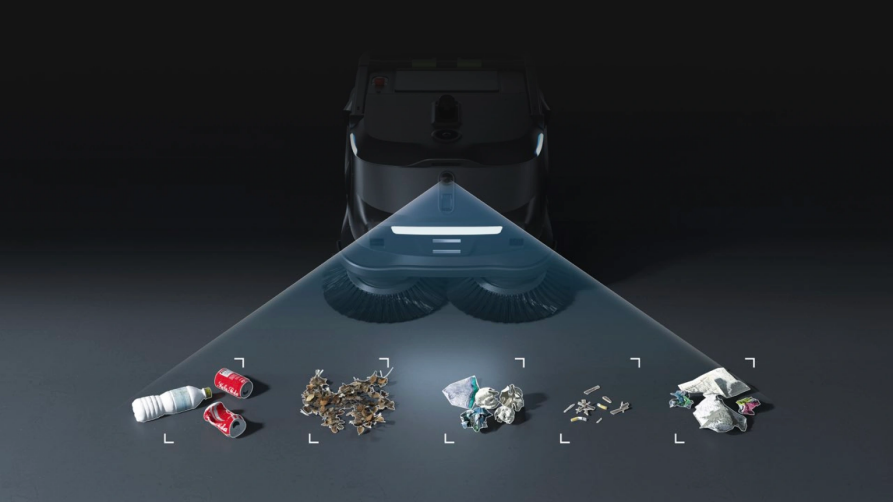
Figure 1. Industrial autonomous sweeper detecting and collecting a mix of bottles, cans, organic debris, foil, and paper waste, the operational shape of cleaning on a recycling-line floor.
The facility deployed a PUDU MT1 industrial autonomous sweeper on its new recycle line. The task scope is focused: continuous, scheduled sweeping of the line floor area to collect dust, fine debris, and small waste fragments that accumulate as material crosses the line. Operators no longer carry the daily cleaning workload on that area. The robot runs around the clock, on a schedule the facility manager configures.
What deserves emphasis is the shape of the deployment, not the unit count. A single robot covering the new line is the right size for the workload. Adding more units before the first one is validated would be a procurement mistake; it would overspend on coverage that has not been proven. A single-unit first deployment is also the most defensible to operations and finance, because the line manager can compare before-and-after hygiene state and operator workload directly.
24/7 sweeping is the part that changes the hygiene baseline
The capability that most often produces a double-take from operations leaders is the move from scheduled cleaning to continuous cleaning. A scheduled cleaning shift is reactive: dust and debris accumulate between shifts, and the floor is at its dirtiest right before the cleaner arrives. A continuous cleaning loop is preventive: the floor is reset hour by hour, so it never approaches the worst-case state that previously triggered safety incidents, audit findings, or equipment fouling.
Operationally, the reason this is possible is that an industrial sweeper class robot can stay on the floor outside human working hours without supervision, charge itself, and pick up where it left off. The line does not need a dedicated overnight cleaner. Weekends and shift changeovers are no longer hygiene gaps. The line is at its cleanest at the start of every shift, not at the end of the cleaning cycle.
Buyers reading this should understand the procurement implication directly: 24/7 sweeping is not a productivity gain on an existing cleaning shift. It is a hygiene-baseline shift that changes what the floor looks like to operators, OEM customers, and regulators. That is much easier to defend in an audit conversation than incremental time savings, and it is the right frame for the procurement business case.
Operator burden reduction is the procurement-friendly framing
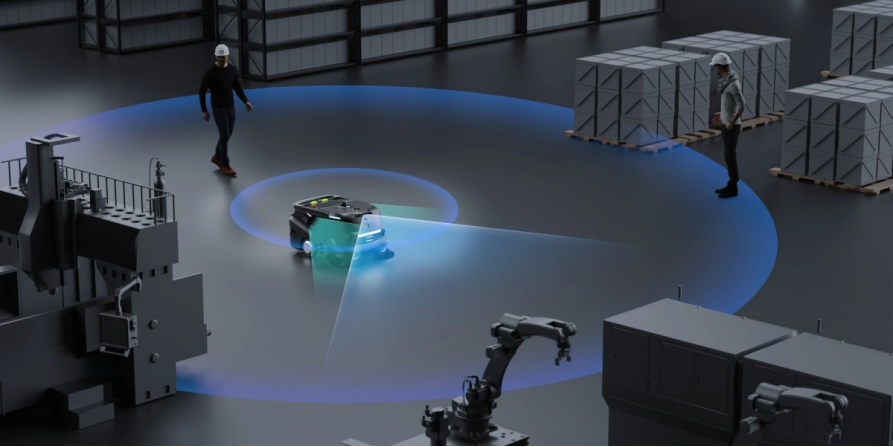
Figure 2. Industrial autonomous sweeper coexisting with operators and equipment in a busy industrial environment.
The second operational lever is labor burden reduction, framed as labor redeployment rather than labor replacement. In a recycling and waste-processing facility, the staff who would otherwise be running daily floor cleaning are the same staff who carry quality control, material sorting, line oversight, and equipment monitoring. Pulling them off cleaning duty puts them back on the work that genuinely benefits from human judgment and experience.
Facility managers should frame the procurement decision exactly this way. The fleet does not eliminate a team. It absorbs the most repetitive, lowest-judgment task in the daily plan, and gives the team back the hours that were costing the line in opportunity, not in headcount. That framing tends to pass operations review, safety review, and works-council discussion faster than any version that leads with cost reduction.
There is one additional benefit that recycling-facility teams call out consistently after a first deployment: the most physically demanding part of the cleaning duty (sweeping dust and small debris off a busy line floor) is the part that operators most often dislike. Removing it changes the morale baseline along with the hygiene baseline. That is not a marketing claim; it is the actual reason these projects often expand from one line to several within the same facility.
Four operational features of recycling lines that shape robot selection
Pudu Robotics field engineering has installed cleaning and industrial robots across multiple facility-management and industrial categories. Four patterns repeat across recycling and waste-processing sites, and each one changes the calculus for what kind of sweeper fits.
1. The debris profile is mixed, not uniform
A recycling line floor carries dust, paper, foil, plastic flake, small organic debris, and occasional larger fragments at the same time. A consumer-grade vacuum or a single-mode floor scrubber will not handle that mix. The sweeper class procurement requirement is strong suction, durable brushes, and a debris bin sized for a continuous shift, not for a 30-minute hotel-lobby pass.
2. The floor is active, not empty
Recycling lines have operators walking the floor, forklifts moving material, and equipment cycling. Compact footprint, layered perception (camera, lidar, depth sensing), and a safety design that handles unpredictable human motion are not nice-to-haves. They are the difference between a robot that runs continuously and a robot that stops every five minutes.
3. The deployment has to land without disrupting the line
Recycling lines run to throughput targets that do not give a facility manager a week of integration time. The sweeper deployment has to start during normal operations and stay out of the way of material flow. Vendors that demand a multi-day integration phase on a live line are not the right shape of partner for this category.
4. Hygiene metrics matter for downstream value
Recycled material is sold to OEM customers who increasingly evaluate the cleanliness of the processing environment as part of supplier qualification. A clean line floor is not just an operations preference; it is a downstream value driver. Facility managers should frame the procurement decision in those terms when they take it to finance or the board.
Workflows in a recycling facility that fit an autonomous industrial sweeper
Once you accept that the entry point is a focused sweeping coverage zone rather than a plant-wide robotics platform, the next question is which zones. The matrix below summarizes the workflows where an industrial autonomous sweeper like MT1 fits cleanly in a recycling and waste-processing facility.
| Workflow | Typical debris | Fit for an MT1-class autonomous industrial sweeper | Why |
| Continuous sweeping along an active recycling line | Dust, paper, plastic flake, small organic debris | Strong | Standardized, recurring, high-frequency; the canonical entry workflow. |
| Overnight and weekend cleaning of the line floor | Accumulated dust and small debris from the shift | Strong | 24/7 operation closes the gap that scheduled cleaning shifts cannot cover. |
| Common-area floor cleaning around the line (corridors, staging) | Mixed debris, dust | Good | Predictable routes and obstacle profile; pays back as the second workflow after the line is validated. |
| Sorting cabin or QC area floor cleaning | Fine debris, dust | Good | Workflow itself fits, but evaluate clearance and acoustic considerations for the operator team in the cabin. |
| Outdoor yard cleaning (loading dock, scrap area) | Heavy debris, large items | Out of scope | Use heavy-duty outdoor sweeping equipment with appropriate certifications. |
| Hazardous or wet-processing area cleaning | Liquid, slurry, chemical residue | Out of scope | Use purpose-built wet-cleaning equipment with hazardous-environment certifications. |
Table 1. Workflow-fit matrix for an autonomous industrial sweeper in a recycling and waste-processing facility.
The first two rows are the natural entry workflows, and the Japanese recycling deployment lands directly in them. They share four properties that make them safe first projects: predictable debris profile, recurring schedule, no human-supervision dependency, and a clean before-and-after measurement frame for the facility manager.
What the MT1 contributes operationally
Figure 3. Industrial autonomous sweeper using layered perception to navigate operators and equipment in a real industrial environment.
The PUDU MT1 is built for exactly the constraints described above: an industrial sweeper class with strong suction for fine debris, durable brushes for mixed waste, layered perception for safety in mixed-traffic environments, autonomous charging for continuous operation, and 24/7 scheduling that the facility manager configures without a coordinator on duty. The combination matches the floor a recycling line actually has, not the floor a generic commercial-cleaning robot is designed for.
In the Japanese deployment, the operationally interesting capability is the unattended runtime. The robot does not need an operator to dispatch tasks, does not need a supervisor during the overnight shift, and does not need manual intervention to handle a normal mix of recycling-line debris. That is what keeps a single-unit first deployment economical, and what makes the labor-redeployment math hold up across a normal operating month.
Where Pudu Robotics fits in the global service robotics landscape
Recycling-facility managers reasonably want to know who they are buying from before placing an industrial sweeper on a working line. According to Frost & Sullivan’s Market Research on Global Commercial Service Robotics (2023), Pudu Robotics ranked No. 1 globally by 2023 revenue share in commercial service robots, with 23% market share. KEENON Robotics held 11%, Gausium 8%. For an industrial-facility buyer, that signal matters as a deployment-base signal: the vendor has the install base to harden product, the service depth to support multi-site operations, and the engineering capacity to keep iterating on cleaning and industrial robot product lines that smaller vendors cannot sustain.
Inside that portfolio, the MT1 industrial sweeper sits on the cleaning side of the product line, distinct from the T-series industrial delivery robots. The capability set is purpose-built for industrial floor cleaning rather than retrofitted from a commercial hospitality product, which is the right shape for a recycling or waste-processing environment.
What recycling-facility managers should evaluate next
If the deployment pattern described in this article fits your facility, the most useful next step is not an enterprise RFP for a facility-automation platform. It is a single-line first deployment with a documented before-and-after hygiene comparison and a clear replication plan to additional lines if the first deployment passes.
From there, four questions decide whether an autonomous industrial sweeper like PUDU MT1 belongs in your facility:
– Can the sweeper handle the actual debris mix of your line (dust, paper, foil, plastic flake, small organics) without manual emptying between shifts?
– Does the safety design support mixed-traffic running with operators, forklifts, and active material movement, without stopping every few minutes?
– Does the vendor have a documented 24/7 unattended runtime case in a comparable industrial environment, including overnight and weekend coverage?
– What is the vendor’s regional service footprint and parts availability in your country and across the facilities you intend to expand to?
The answers tend to resolve into a single-line first project per facility, not an enterprise platform purchase. That is the right shape for a category where the hygiene baseline matters more than the unit count, and where labor redeployment matters more than labor elimination.
FAQ
Why deploy a robot for floor cleaning instead of adding a cleaning shift?
Because the value is a continuous hygiene baseline, not incremental cleaning hours. A scheduled cleaning shift leaves the floor at its dirtiest right before the shift starts. A continuous autonomous loop never approaches that state, which is what changes the audit and OEM-qualification story.
Does this replace cleaning staff?
The credible business case is labor redeployment: the staff who would otherwise be running daily floor cleaning are redeployed to QC, sorting, line oversight, and equipment monitoring. Headcount usually adjusts through normal attrition, not through displacement.
Will the sweeper handle the mix of debris a recycling line actually produces?
An industrial sweeper class robot is designed for exactly this mix (dust, paper, foil, plastic flake, small organics). A consumer-grade vacuum or a commercial-hospitality floor scrubber is not the right product class. Ask the vendor for a documented debris-profile case in a comparable facility before signing.
How long does deployment take on a live recycling line?
On the order of hours, not weeks, when the vendor uses infrastructure-free positioning and the sweeper is configured against a focused coverage zone rather than a plant-wide map. Vendors that demand a multi-day integration phase on a live line are not the right shape of partner for this category.
How should we evaluate vendors beyond the spec sheet?
Three checks separate viable vendors from optimistic ones: a documented 24/7 unattended runtime case in a comparable industrial environment, a debris-profile case that matches your line, and a regional service-coverage plan covering response time, spare parts, and software updates across the facilities you intend to expand to.
References & Further Reading
1. International Solid Waste Association (ISWA). Global recycling industry data and policy frameworks. https://www.iswa.org/
2. Japan Ministry of the Environment. Waste management and 3R policy reports. https://www.env.go.jp/en/recycle/
3. International Federation of Robotics. World Robotics 2024. https://ifr.org/
4. Frost & Sullivan. Market Research on Global Commercial Service Robotics (2023). https://www.frostchina.com/en/content/insight/detail/66b96cfadce2a58aa58ac492
5. Pudu Robotics. PUDU MT1 industrial autonomous sweeper. https://www.pudurobotics.com/en/products/mt1
6. Pudu Robotics. Smart manufacturing case study, multi-robot collaboration. https://www.pudurobotics.com/en/case-studies/pudu-tri-robot-battery
