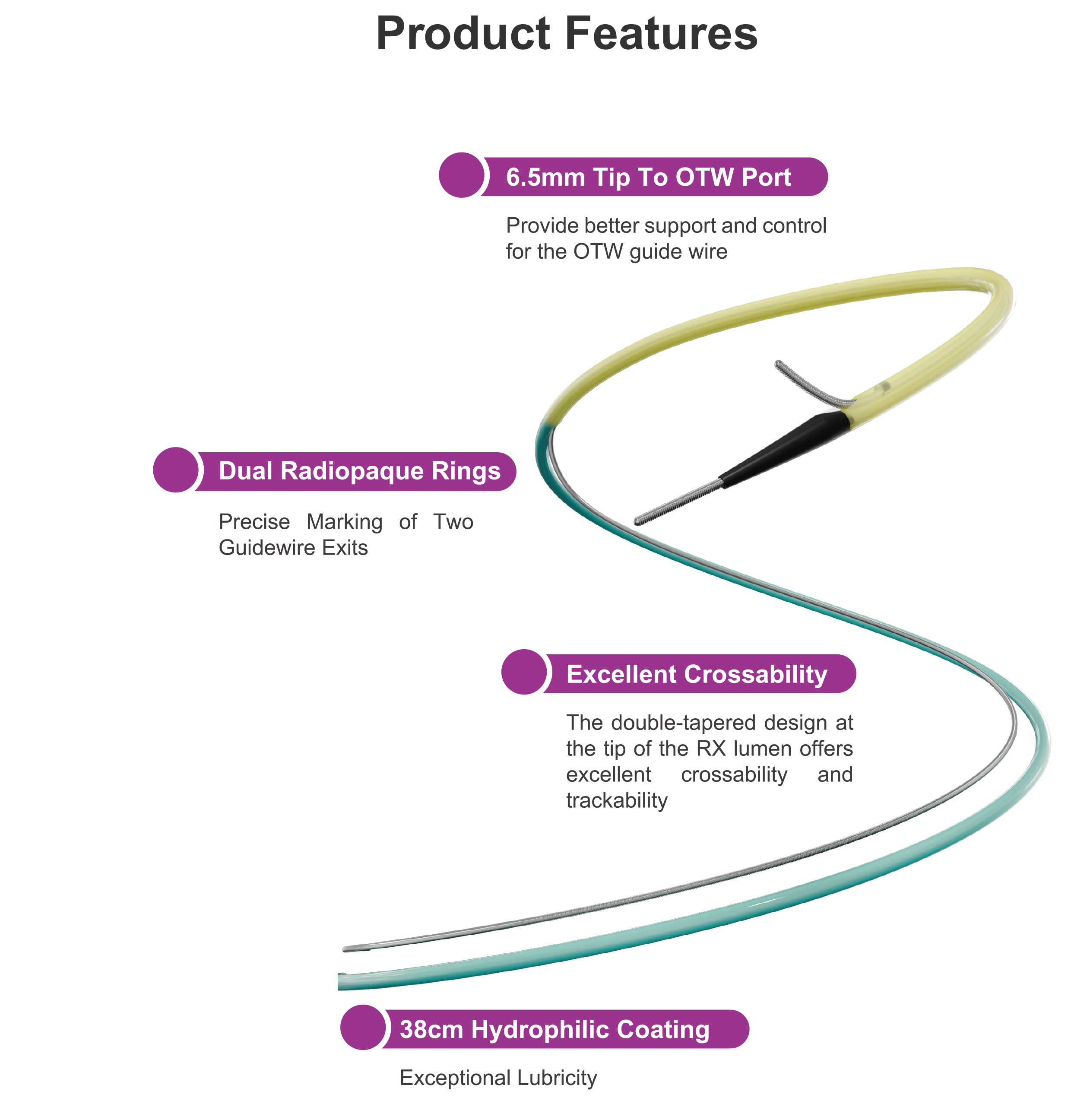
In complex coronary intervention, a microcatheter may need to do more than provide a pathway for a guidewire. In bifurcation lesions, chronic total occlusions, and other challenging anatomies, the position of different guidewire exit ports can directly affect how the device is used. For procurement teams and medical-device distributors, this makes radiopaque marker positioning an important design feature to understand when comparing double lumen catheter products.
A double-lumen design provides two separate wire pathways, allowing independent handling of two guidewires. Unlike a conventional single-lumen microcatheter, where a product uses distinct guidewire exit ports, their location can be an important consideration during fluoroscopic positioning. Radiopaque markers therefore have a practical role in helping users understand the relative position of the catheter tip and wire exit points.
Why Radiopaque Positioning Matters in a Double Lumen Microcatheter
Double-lumen microcatheter designs can use separate guidewire pathways, with the configuration and exit-port arrangement varying by product design. The rapid-exchange lumen exits at the distal tip, while the over-the-wire lumen generally has a separate exit port positioned proximally. This arrangement allows two guidewires to be handled independently and is particularly relevant to bifurcation and CTO techniques.
Because the two exit points are not located in the same position, visual identification under fluoroscopy becomes important. Radiopaque markers can indicate where the relevant lumen exits are located. This gives the operator a visual reference when positioning the catheter relative to a side branch or another target pathway.
The distinction is important for manufacturers because simply stating that a device is “radiopaque” provides limited technical information. A more useful product description should explain where the markers are positioned and what anatomical or procedural reference each marker provides.
How Marker Positioning Supports Device Positioning
The relationship between marker location and lumen exit is particularly relevant when a second guidewire needs to enter a side branch. In double-lumen catheter designs that use radiopaque markers to indicate different exit locations, marker positioning can provide an important fluoroscopic reference. Buyers should therefore verify the number, location, and function of the markers from the current product documentation.
For example, in a bifurcation, one guidewire may already occupy the main vessel while a second wire needs to be directed toward a side branch. The catheter’s two-lumen architecture allows the second wire to be introduced through a separate pathway. The marker positions provide visual information about the location of the corresponding exits.
This does not mean that marker positioning alone determines procedural performance. Catheter tip profile, shaft flexibility, trackability, inner-lumen dimensions, guidewire compatibility, and the geometry of the target anatomy also influence device selection. Expert guidance recommends considering these characteristics together when choosing microcatheters for complex PCI.
What Buyers Should Check in a Double Lumen Catheter
For hospitals and distributors, the radiopaque-marker design should be evaluated together with the complete product specification. A useful procurement review can include several questions.
First, where is each radiopaque marker located relative to its corresponding lumen exit? Second, how clearly does the product documentation identify the distal tip and secondary exit point? Third, what are the catheter’s outer and inner diameters? Fourth, which guidewire sizes are compatible with each lumen? Finally, what are the available catheter lengths and guiding-catheter compatibility requirements?
These details allow buyers to compare products according to actual configuration rather than relying on broad claims. Published expert guidance shows that available double-lumen microcatheters differ in length, outer diameter, inner-lumen dimensions, marker distance, hydrophilic-coating length, and guiding-catheter compatibility.
For distributors, clearly documented specifications are also important when preparing product registrations, technical quotations, and customer documentation across different markets.
Why Radiopacity Should Be Described Precisely
Radiopacity is not simply a yes-or-no product attribute. Its usefulness depends on the position and purpose of the marker. In a double-lumen system, the marker should provide a meaningful visual reference for the different lumen exit locations.
This is particularly relevant because the two lumens serve different functions. The distal rapid-exchange pathway and the more proximal over-the-wire pathway can be used for different guidewire-handling strategies. Literature on double-lumen systems specifically identifies marker bands as references for these exit ports.
Manufacturers should therefore avoid vague wording such as “excellent visibility” unless it is supported by appropriate documentation or testing. A more informative description identifies the marker material or configuration, location, and relationship to the catheter’s distal tip when such information is available.
Evaluating Shunmei’s Double Lumen Catheter-Lumin
Shunmei lists the Lumin Double Lumen Catheter within its Coronary Intervention portfolio. The official product page identifies the product as “Double Lumen Catheter-Lumin,” provides model-level specifications for effective length, catheter dimensions, lumen dimensions, coating length, and the distance between the OTW port and the catheter tip.
For professional buyers, this distinction matters. Rather than assuming specifications that are not published on the product page, procurement teams should request the current product brochure and technical documentation directly from the manufacturer. The requested documentation should be checked for marker positioning, lumen configuration, dimensions, guidewire compatibility, available models, and regulatory information.
The wider Shunmei coronary portfolio includes microcatheters and other interventional catheter categories, which can also be considered when distributors are assessing the supplier’s product coverage.
Building a More Useful Procurement Checklist
When evaluating a double lumen microcatheter, buyers can organize their review around five areas: lumen configuration, radiopaque-marker positioning, catheter dimensions, guidewire compatibility, and documentation.
The key is to connect each specification with its practical purpose. Marker placement should identify the relevant exit ports; lumen dimensions should correspond with the intended guidewire configuration; catheter dimensions remain compatible with the planned access system; and product documentation clearly establishes the applicable specifications and limitations.
For procurement teams considering Shunmei, the Lumin product page can serve as the starting point for product review. Buyers can then contact the manufacturer to obtain the latest technical specifications and product documentation before assessing whether the configuration fits their coronary intervention requirements.
