Commercial PV projects rarely have perfectly uniform array layouts. Rooftops may face different directions, available roof sections can have different tilt angles, and nearby structures may introduce partial shading. These conditions can create multiple PV subarrays with different electrical behavior. For system integrators, EPC contractors, and commercial energy developers, selecting the right solar inverter for multi mppt hybrid solar solution requires careful attention to MPPT architecture, voltage ranges, battery integration, and operating modes.
Why Complex PV Layouts Need Multiple MPPTs
Maximum power point tracking allows an inverter to continuously adjust its operating point to capture available PV power. When multiple array sections have substantially different orientations, shading patterns, or operating voltages, treating them as one uniform array can create mismatch between the available power and the inverter’s operating point.
The U.S. National Renewable Energy Laboratory’s System Advisor Model specifically supports separate subarrays with different string lengths, orientations, shading conditions, and tracking configurations. It also allows individual MPPT inputs to be assigned to different subarrays.
This makes multiple MPPT trackers particularly relevant for commercial rooftops, industrial facilities, carports, and other sites where PV modules cannot all be installed under identical conditions.
Start With Array Orientation and Shading
Before selecting a hybrid inverter, designers should map the physical PV layout. A commercial building may have one roof section facing east, another facing west, and additional modules installed on a differently angled structure. These areas can receive different irradiance profiles throughout the day.
Shading can make the situation more complicated. Trees, parapets, HVAC equipment, neighboring buildings, and rooftop structures can affect only part of an array. NREL’s modeling guidance recognizes orientation, tracking, and shading as separate subarray characteristics when designing PV systems.
Assigning electrically different array sections to separate MPPT circuits can help the system respond to their individual operating conditions instead of forcing all sections to behave as one string group.
Check MPPT Voltage and String Design
Multiple MPPTs do not remove the need for proper string sizing. The PV string’s open-circuit voltage must remain within the inverter’s maximum DC voltage, while its operating voltage needs to fall within the applicable MPPT voltage range.
NREL’s System Advisor Model uses these parameters when evaluating PV array configuration. Its guidance checks string Voc against maximum DC voltage and string Vmp against the inverter’s minimum and maximum MPPT operating limits.
For commercial projects, engineers should therefore calculate string voltage across expected temperature conditions and confirm the number of strings connected to each tracker. MPPT count is useful only when the associated PV inputs are electrically configured within the inverter’s actual limits.
Consider Battery Integration Alongside PV
A hybrid solar project adds another design layer because the inverter may simultaneously manage PV generation, battery charging and discharging, grid interaction, and backup operation.
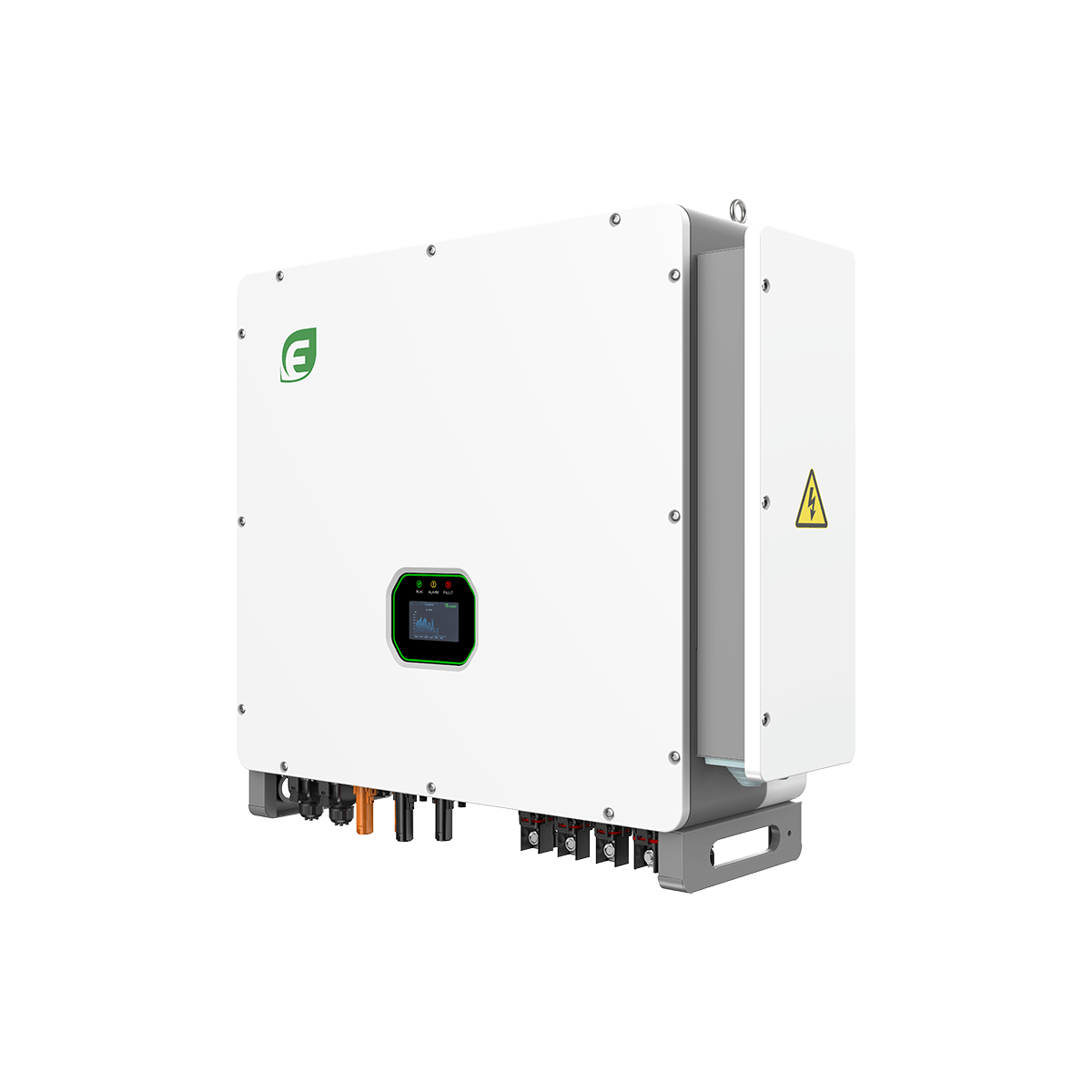
This is where an integrated architecture can reduce the number of separate power-conversion stages. Enjoypowers’ 75–125 kW IP66 hybrid inverter combines PCS, DC-DC, MPPT, STS, and EMS functions in one outdoor enclosure. The published product information identifies support for PV input, battery management, and on-grid/off-grid AC output for commercial PV plants and microgrids.
Its specified battery voltage range is 180–950 Vdc, with LFP, NMC, and sodium-ion batteries listed for compatibility. This wide range can accommodate different commercial battery configurations, subject to detailed BMS and system integration requirements.
Evaluate the Number of Independent MPPT Trackers
The number of MPPT inputs should be considered against the actual number of electrically different PV subarrays rather than treated simply as a specification to maximize.
Enjoypowers’ product page presents a 125 kW configuration with 10 independent MPPT trackers and a maximum PV input current of 42 A × 10. The same product page also describes four independent MPPT trackers as a feature for handling complex commercial PV arrays. Because the detailed specification table lists 10 MPPTs, project teams should verify the exact MPPT configuration for the selected model and datasheet revision before procurement.
This distinction is important when preparing a technical proposal or electrical single-line diagram.
Look Beyond MPPTs to Hybrid Operating Modes
A commercial hybrid inverter must support the site’s energy strategy, not just maximize PV production. Typical applications can include self-consumption, peak shaving, time-of-use energy arbitrage, grid-connected operation, off-grid operation, and genset support.
Enjoypowers lists these five operating modes for its 75–125 kW hybrid inverter and states that its EMS coordinates PV, battery, grid, and genset priorities. The inverter is specified for 400 V three-phase AC operation, with 125 kW on-grid and off-grid rated power for the 125 kW model.
For commercial buyers, these functions can be important when the PV system is expected to provide both energy-cost management and resilience.
Check Transfer Performance for Critical Loads
A hybrid system used for backup must also be evaluated according to its transition behavior. A facility with production equipment, communications infrastructure, or other critical loads may have different tolerance requirements from a building using solar primarily for energy savings.
Enjoypowers specifies a grid-to-off-grid and off-grid-to-grid transfer time of less than 10 ms for its 125 kW hybrid inverter. The company describes a shared control bus between PV input, battery, and AC output to support this switching performance.
The suitability of this response should still be verified against the site’s load characteristics, protection scheme, and applicable power-quality requirements.
Consider Outdoor Installation and System Integration
Commercial PV systems are often installed where indoor electrical rooms are limited or expensive to build. Environmental protection can therefore become an important procurement criterion.
The Enjoypowers hybrid inverter has an IP66 rating for outdoor wall or pad mounting. Its published operating temperature range is −40°C to 60°C, with derating above 50°C, and it uses smart forced-air cooling with a sealed compartment design. Maximum efficiency is specified at 97.8%.
For harsh commercial and industrial sites, engineers should still evaluate ambient temperature, ventilation, corrosion exposure, maintenance access, cable routing, and mounting conditions during site design.
Choosing an Inverter for Complex Solar-Plus-Storage Projects
A suitable solar inverter for multi mppt hybrid solar projects should be selected from the entire system perspective. Array orientation, shading, string voltage, MPPT allocation, battery voltage, AC requirements, transfer performance, environmental conditions, and EMS functionality all influence the final architecture.
For commercial microgrids, projects evaluating grid-forming inverter for microgrid applications may also consider when the system must establish and maintain its own local electrical conditions during islanded operation. The right architecture depends on the facility’s operating strategy and grid requirements.
Enjoypowers’ 75–125 kW hybrid platform demonstrates how PV conversion, battery management, MPPT tracking, transfer switching, and energy management can be consolidated into an outdoor enclosure.
For EPCs and commercial project developers, the most effective approach is to begin with the physical and electrical characteristics of the PV array, then select an inverter whose MPPT architecture and hybrid functions match those requirements. This turns multi-orientation and partially shaded commercial rooftops from a layout challenge into a manageable system-design consideration.
