UV 3D resin has become an important consumable for dental laboratories, orthodontic production, and other additive manufacturing workflows. However, print quality depends on more than printer calibration and slicing parameters. How resin is received, handled, stored, mixed, and returned to storage can affect material consistency and production reliability. For business buyers, establishing proper resin management procedures is therefore essential for reducing waste and maintaining repeatable results.
Why Proper UV 3D Resin Handling Matters
Photopolymer resin is designed to react to specific light wavelengths during printing. Uncontrolled exposure to ambient or UV light can gradually initiate curing and alter the material before it reaches the printer. Manufacturer instructions commonly recommend keeping resin in its original packaging, tightly closed, and protected from direct sunlight.
Temperature can also influence resin behavior. Dental resin manufacturers may specify a particular operating or storage range for individual formulations. Therefore, production teams should always prioritize the technical data sheet, instructions for use, and safety data sheet supplied for the exact material rather than applying one storage rule to every resin.
Choose the Right Storage Environment
A suitable storage area should be dry, clean, and protected from direct sunlight and unnecessary heat. Liquid resin should remain in its original, properly labeled container whenever practical. The container should be closed promptly after dispensing material to limit light exposure, contamination, and accidental leakage.
Businesses should also avoid storing resin near sources of strong UV light. NextDent’s instructions, for example, recommend storing dental resin in its original packaging or a closed resin tray in a dry, dark area and explicitly advise avoiding UV-light exposure.
A dedicated storage area makes inventory control easier as well. Production teams can organize materials by product type, batch, application, and expiration date. This is particularly useful for laboratories managing multiple dental applications and printer platforms.
Handle Containers Carefully During Production
Good handling starts before the bottle is opened. Staff should inspect packaging for damage or leakage and verify the material name, batch information, and expiration date. Resin should not be transferred into an unlabeled container because doing so can make material identification and traceability difficult.
When dispensing resin, avoid unnecessary splashing or contamination. Keep caps and bottle openings clean, and close containers immediately after use. Appropriate personal protective equipment should also be used according to the product’s SDS. Guidance from photopolymer resin manufacturers commonly emphasizes avoiding skin and eye contact and wearing suitable protective equipment when handling liquid resin.
Mix Resin Before Printing When Required
Some photopolymer formulations contain pigments or other components that can settle during storage. Insufficient mixing can therefore affect color, material uniformity, and print consistency. The correct mixing procedure depends on the specific product and should follow its instructions for use.
For example, a NextDent dental resin instruction document recommends thorough mixing before use and specifies different mixing requirements depending on whether the material is being used for the first time or subsequently. It also advises users not to mix different batches of the same product.
For production laboratories, this means resin preparation should become part of the standard operating procedure rather than an informal step performed only when problems appear.
Match Resin With the Correct Printer
Compatibility should be confirmed before purchasing or pouring resin into a printer. Important factors include the required curing wavelength, printing technology, exposure settings, layer thickness, and intended application.
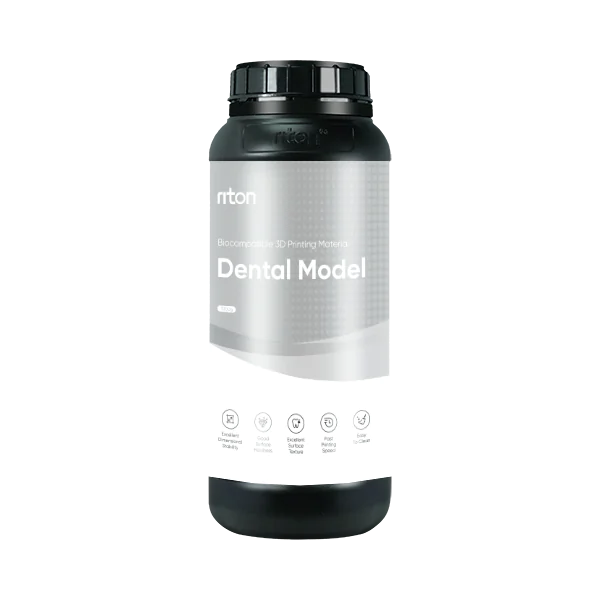
Riton’s Model S1.0, for example, is a dental photopolymer material designed for dental models and suitable for mass production. Its official specifications identify a 385–405 nm applicable wavelength and compatibility with LCD/DLP equipment. It is supplied in 1 kg bottles and is intended for applications including removable prosthodontics and orthodontics.
This illustrates why buyers should assess a UV 3D resin supplier based on documented compatibility rather than assuming that all 385–405 nm resin formulations will perform identically across all printers.
Manage Resin in the Printer Carefully
Resin management should continue after material enters the printer. If resin remains in a tank between jobs, the tank should be protected from unnecessary ambient light and contamination. Printer manufacturers may provide specific procedures for covering, cleaning, mixing, or storing resin tanks.
Formlabs, for example, recommends storing resin tanks on a clean, level surface away from direct sunlight when they are removed from the printer. It also recommends labeling tanks to track the resin type and age.
Dental laboratories can apply the same principle by assigning clear identification to tanks and avoiding unnecessary cross-contamination between different resin types.
Control Inventory and Expiration Dates
Resin inventory should be managed using a first-expire, first-out approach where practical. Each bottle should remain traceable to its product name, batch, and expiration date. Opened materials should be managed according to the manufacturer’s instructions because opening the container can introduce additional environmental exposure.
Expired or improperly stored resin may no longer provide the properties specified by the manufacturer. Leading photopolymer resin manufacturers explicitly state that their resins are no longer guaranteed to meet specified properties after the expiration date.
For business operations, simple inventory records can prevent unnecessary waste while helping production teams investigate quality issues.
Work With Qualified Dental 3D Printing Resin Manufacturers
Choosing among dental 3D printing resin manufacturers should involve more than comparing price per kilogram. Buyers should evaluate technical documentation, application coverage, printer compatibility, certifications, consistency between batches, and technical support.
Riton develops resin materials specifically for dental applications, covering categories such as dental models, surgical guides, gingiva masks, casting wax, splints, try-ins, denture bases, trays, crowns, and denture teeth. Its resin portfolio has select materials holding certifications such as NMPA and FDA.
For example, Riton Model S1.0 is positioned around fast molding, easy cleaning, mass production capability, high-temperature resistance, and cost efficiency. This specific material lists material certifications of NMPA, FDA, and CE.
Build a Consistent Resin Management Procedure
The most effective approach is to turn good practices into documented procedures. A laboratory can establish checkpoints covering incoming inspection, storage, bottle opening, mixing, printer loading, tank management, cleaning, inventory rotation, and disposal.
Liquid resin waste should also be handled according to the applicable SDS and local regulations. Manufacturer guidance can differ between formulations, so staff should not assume that one disposal method applies universally. For example, leading photopolymer resin manufacturers advise treating liquid resin as chemical waste and following applicable local regulatory requirements.
Protecting Resin Quality From Storage to Production
Proper UV 3D resin handling is ultimately a quality-control issue as much as a safety or housekeeping concern. Protecting resin from unwanted light, controlling its storage environment, maintaining batch traceability, following mixing instructions, and matching materials with compatible equipment can help dental laboratories achieve more consistent production.
For businesses evaluating dental 3D printing resin manufacturers, documented material specifications and application-specific support should be key purchasing criteria. Riton’s S1.0 demonstrates this application-focused approach, combining defined wavelength compatibility, LCD/DLP support, 1 kg packaging, dental applications, and listed certifications for professional workflows.
