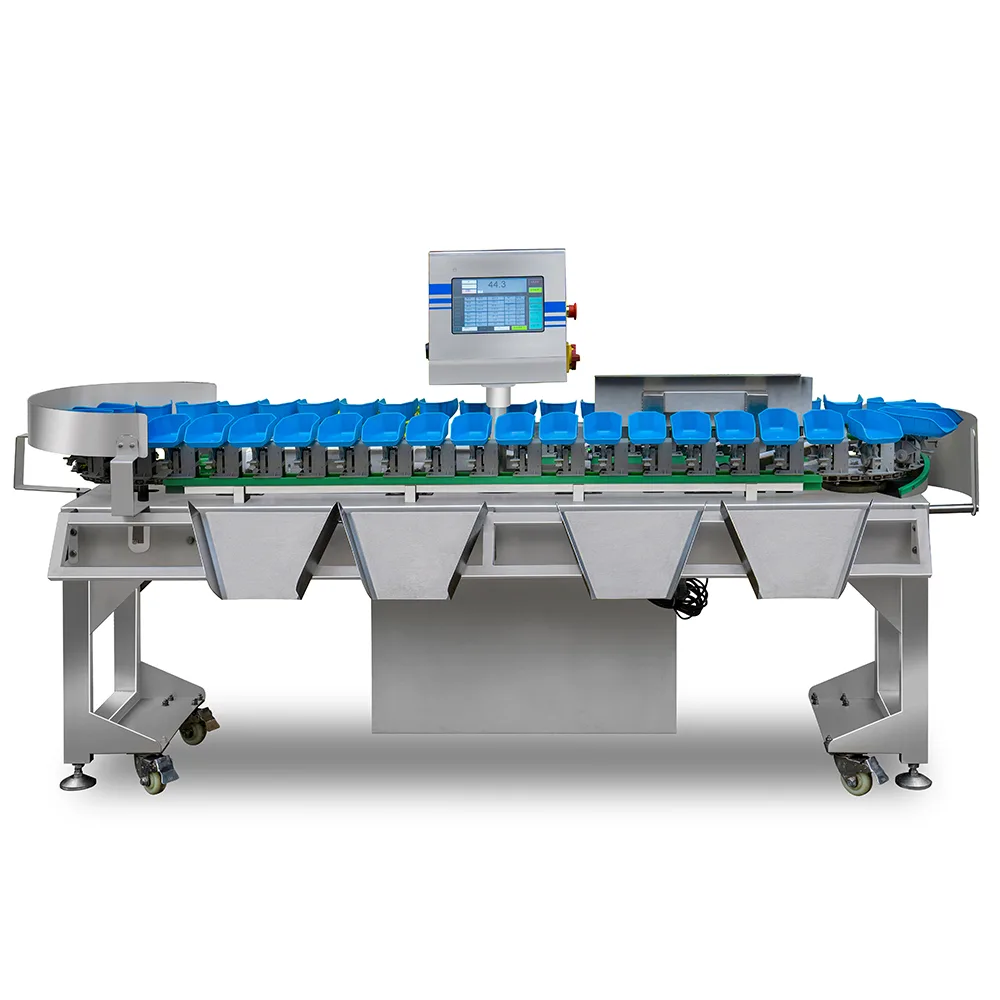
Fish rarely arrive at a processing line with identical weights. Even within the same catch or production batch, size variation can be substantial. Manual grading becomes difficult when volumes increase, particularly when processors need consistent weight categories for different customers, products, or packaging specifications. A fish sorting machine addresses this problem by measuring individual products and directing them into predefined weight groups during continuous production.
For commercial processors, accurate grading is not simply about replacing manual labor. It affects product consistency, downstream handling, yield control, and the ability to manage different grades efficiently. Easyweigh provides weight-grading solutions designed for fish processing lines, using high-precision sensing, automated classification, and production-line integration.
Why Fish Grading Becomes Difficult at Production Scale
Small differences in fish weight are easy to overlook during manual inspection but become significant across high-volume production. Workers must identify products, estimate or measure weight, and place each fish into the correct category. Repeating these decisions throughout a shift introduces opportunities for inconsistent classification.
A fish sorting machine changes the workflow by assigning the measurement task to an automated system. Each product passes through the weighing stage, where its weight is measured and compared with configured grading ranges. The system can then route the fish toward the appropriate output category.
The underlying challenge is therefore not merely speed. Reliable grading requires repeatable measurement while products are moving through the production line. That consistency provides a stronger foundation for packaging, pricing, and downstream processing.
How Dynamic Weighing Turns Individual Fish Into Reliable Grades
Accurate grading begins with the weighing system. The Weight Sorting platform uses high-precision sensors and automated calibration to support weight-based classification. Its published specifications list weight-grader accuracy ranges of ±1 g to ±5 g for certain single- and dual-lane models, depending on configuration.
Weight categories can then be configured around the processor’s product requirements. Instead of asking an operator to judge whether a fish belongs in one grade or another, the automated system applies predefined parameters consistently.
Dynamic weight grading is particularly useful where product characteristics vary throughout a batch. The system can automatically categorize products according to their measured weight, helping maintain consistent groups while reducing unnecessary manual intervention and product giveaway.
Where Handling Design Protects Weighing Accuracy
Measurement accuracy depends on more than the sensor itself. Fish must reach the weighing area in a controlled and repeatable manner. Movement, slipping, unsuitable contact surfaces, or inconsistent product positioning can interfere with reliable measurement.
Different machine configurations address different handling requirements. The single-lane grader, for example, can use POM or stainless-steel chain materials selected for stability and reduced product sliding. Dual-lane equipment processes products on two lanes simultaneously, while rotating-tray configurations are designed to handle softer, thinner, or more viscous products.
Such mechanical choices are important in fish processing because product characteristics can vary significantly between whole fish, fillets, squid, salmon, cuttlefish, and octopus. The appropriate transport and grading configuration should match the physical properties of the product rather than relying on one universal setup.
Why Multi-Grade Control Matters for Commercial Fish Lines
Commercial fish processors rarely need only a simple “light” and “heavy” split. Products may need several weight categories based on customer specifications, packaging requirements, or sales channels.
A Weight Sorting system can divide products into multiple weight categories, allowing one production line to handle more detailed grading requirements. The category boundaries can be configured according to the intended product specification rather than being fixed to one universal grading standard.
This flexibility becomes valuable when the same facility processes different species or product formats. The product list for the equipment includes fish, fish fillets, salmon, squid, octopus, and cuttlefish, among other seafood products.
How Line Integration Changes the Value of Automated Grading
A grader creates greater operational value when it fits naturally into the existing processing workflow. Easyweigh’s fish solution is described as integrating into fish processing lines with real-time monitoring and data analytics.
Integration reduces the need to treat grading as an isolated workstation. Products can move from upstream handling into automated weighing and then continue toward their designated processing or packaging stages.
Real-time monitoring also gives operators greater visibility into production performance. Instead of relying entirely on manual checks, production teams can monitor system information and make adjustments when operating conditions or product requirements change.
What Processors Should Look for in a Fish Grading System
The most suitable fish sorting machine should be evaluated against the actual grading workflow rather than its headline speed alone. Weighing accuracy, product handling, number of grading categories, lane configuration, hygiene requirements, and integration options all influence practical performance.
Easyweigh’s published Weight Sorting range includes single-lane, dual-lane, rotating-tray, and combined visual-inspection and weight-grading configurations. This range allows the equipment configuration to be considered alongside product characteristics and production requirements.
Accurate weight grading ultimately depends on the complete system. A precise sensor is valuable, but consistent handling, suitable grading parameters, stable product flow, and effective integration determine whether that precision translates into dependable production results.
An automated grading system offers a more regulated approach from the measurement of individual weights to the categorisation of final products, ideal for processors that are looking to achieve repeatable fish grades at commercial quantities.
