The term “hammock tent” sounds self-explanatory, but it covers a range of products that behave quite differently. Some are essentially a hammock with a built-in bug net and a small rain tarp overhead, which works in warm, dry climates but is not a full shelter.
Others are closer to a hybrid: a structure that can hang between two anchor points like a traditional hammock, or sit on the ground and work as a tent when there is nothing to hang it from. Knowing which version a product is matters more than the category name, since two products with the same label can differ widely in what they handle once weather or terrain gets difficult.
Where the Concept Started
Hammock camping predates the modern gear market by a long way. Sleeping suspended above the ground has practical roots in staying clear of wet, sloped, or insect-heavy terrain instead of dealing with it the way a ground tent has to.
The trade-off has traditionally been dependency. A suspended hammock needs two solid anchor points spaced correctly apart, which a campsite does not always offer, especially above the treeline, on open rocky terrain, or at a developed site where trees are not positioned conveniently.
That limitation is the gap dual-mode designs are built to close, and it explains why manufacturers began building shelters that do not force a camper to choose one mode permanently.
Ground or Suspended: Why Some Designs Do Both
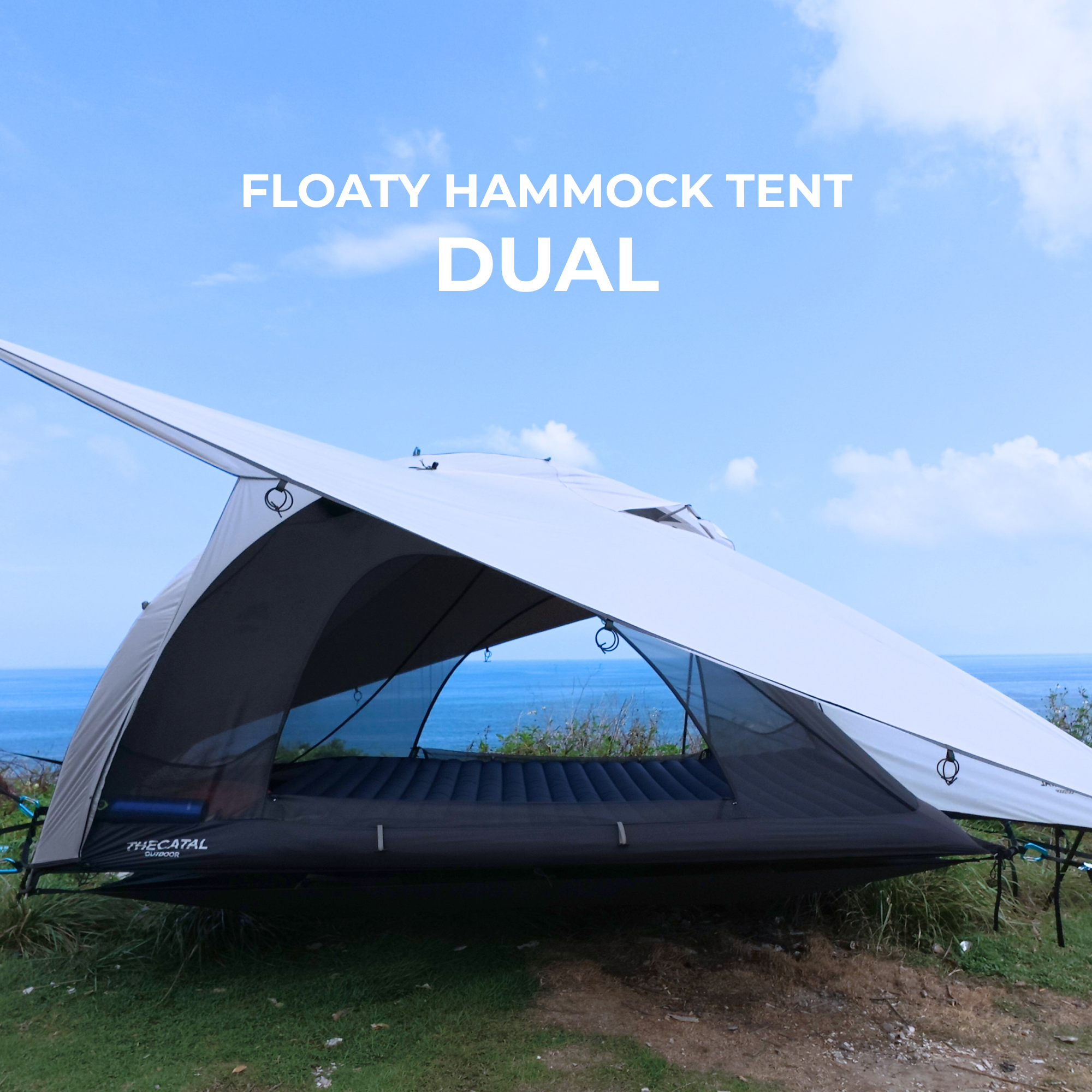
The floaty hammock tent can be set up on the ground like a conventional tent or suspended above it like a traditional hammock. That lets it serve different kinds of terrain without relying on trees or other suspension points.
This addresses a common limitation of hammock-only setups: suitable anchors are not always available along a route. When a campsite lacks two well-placed trees or posts, the ground setup is still an option. For campers planning routes through unfamiliar terrain, having both modes makes it easier to adapt at each stop. Setup takes about 5 minutes, with no complicated poles.
Solving the Shared-Space Problem
Hammock tents have traditionally suited solo camping, since sharing one suspended sleeping space leaves little room for two people and their gear. As a hammock tent for 2, the Floaty approaches this with an adjustable interior that divides the space into zones, so each person keeps some personal space inside the same shelter. That makes shared use more practical than hanging two separate hammocks.
The adjustable layout also challenges the idea that hammock tents suit only solo campers. For couples or travel partners, a measure of separation inside a shared shelter makes it easier to organize sleeping space and belongings.
What a Hammock Tent Offers That a Ground Tent Does Not
The core appeal of a hammock-style shelter comes down to what happens underneath it. Lifting the sleeping area off the ground removes exposure to wet soil, uneven terrain, and ground-level insects that a tent floor has to deal with directly. That can matter on trips through humid or heavily wooded country, where the ground seldom dries between rains.
The Floaty is waterproof and lets the sleeper choose between tree and ground setups depending on the site, which keeps the shelter usable when the terrain changes. None of this means a hammock tent beats a ground tent in general. It shifts which terrain and weather conditions the shelter handles most comfortably, so a camper’s typical trip environment should drive the decision more than a broad claim about one format.
Storage, Setup, and Everyday Use
Storage is a common weak point of light hammock setups, since a suspended sleeping area has little floor space for packs and boots. The Floaty has two built-in vestibules to address this, giving gear a place beside the sleeping area.
Setup speed matters too. With a simple hammock camping setup, a camper can go from backpack to bed in minutes, and the Floaty’s 5-minute setup suits that kind of arrival. The design suits deep woods as well as a backyard retreat, which makes it a flexible choice for people whose trips vary. THECATAL backs it with a two-year warranty.
Deciding Whether a Hammock Tent Fits a Given Trip
The practical way to judge whether a hammock tent suits a trip is to think through the terrain and group size, rather than treating the category as either better or a novelty.
A trip through dense forest with reliable trees favors suspended mode, since the setup goes up quickly without concern for ground moisture or uneven roots beneath a sleeping pad. That is the feature separating a dual-mode design from a hammock-only product that comes with a rain cover but no ground option.
For two people traveling together, it is worth checking whether a hammock tent supports separate zoning before relying on it for a multi-day trip. A “2-person” label does not guarantee the shared comfort of a standard 2-person ground tent, and personal space and gear organization matter more with each passing day.
