Insulation materials are often judged by how effectively they slow heat transfer, but laboratory performance is only part of the story. In clothing, an insulating layer must also bend with the body, remain stable during manufacturing, and withstand everyday handling without compromising comfort. Low thermal conductivity materials can offer useful thermal resistance in compact designs, yet their practical value depends on more than a specification sheet.
Aerogel is widely recognised for its unusual porous structure, while flexible insulation technologies take a different approach to balancing warmth with garment construction. Understanding the differences helps apparel developers assess which material is better suited to a particular application.
Material Structure and the Source of Thermal Resistance
Aerogel is distinguished by an extremely porous internal network. Much of its volume consists of air-filled spaces, while a fine solid framework forms the supporting structure. The small pore dimensions restrict certain forms of heat transfer, helping aerogel achieve very low thermal conductivity. Its performance makes it attractive for applications where high insulation efficiency is required within limited space.
However, aerogel is not a single material with identical properties across every product format. Silica aerogel, for example, may be supplied as granules, blankets, composites, or other engineered forms. A flexible aerogel blanket typically combines aerogel particles with a fibrous support, which improves handling compared with a standalone monolithic aerogel structure. The supporting material and manufacturing process influence the final product’s flexibility, weight, and durability.
Other low thermal conductivity materials use different structural designs to limit heat movement. Flexible polymer-based insulation may rely on fine cells or closed-cell structures to restrict heat transfer while retaining a soft, thin profile. Compared with aerogel composites, these materials may be developed with garment integration in mind, where repeated bending, close body contact, and fabric compatibility are important considerations.
Flexibility and Comfort in Wearable Applications
Garments experience continuous movement rather than the relatively static conditions found in many building or industrial insulation applications. Sleeves bend, elbows compress, and body panels fold as the wearer moves. An insulation layer that performs well in a flat laboratory specimen may behave differently after repeated flexing, particularly if its structure is prone to cracking, shedding, or permanent deformation.
Aerogel blankets can be more flexible than rigid aerogel forms, but their bending characteristics depend on the reinforcement, binder, and overall composite construction. Some formats may tolerate gentle folding while remaining less suitable for sharp creases or repeated compression. Apparel developers should examine the material’s minimum bending radius, recovery after compression, and durability under repeated movement before incorporating it into a garment.
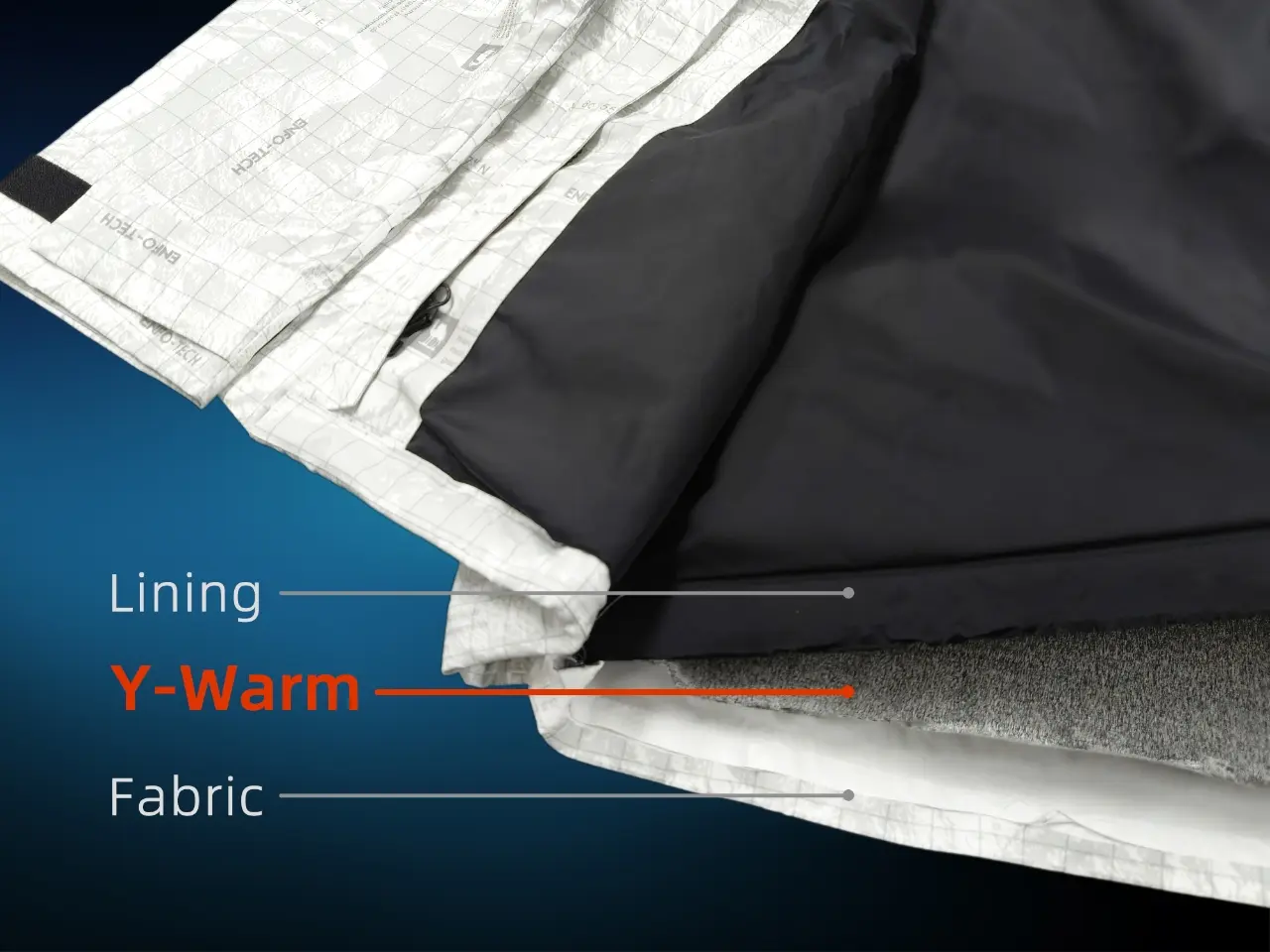
Flexible insulation designed for clothing can offer a different balance of softness and handling. Y-Warm’s YW-01, for example, is specified as a 0.7 mm layer for lightweight thermal jackets intended for use at approximately 8 °C and above, depending on garment construction, activity, and weather conditions. In the suggested assembly, the layer sits between the outer fabric and lining. This application illustrates how low thermal conductivity materials can be assessed through garment-level requirements rather than conductivity figures alone.
Dust Control, Handling, and Manufacturing Considerations
Dust generation is an important issue when processing some aerogel products. Loose aerogel particles or fragments may become airborne during cutting, trimming, or mechanical handling, depending on the product format and its binding system. Manufacturers should consult the relevant safety data sheet and processing instructions, then establish suitable ventilation, protective equipment, and housekeeping procedures for the specific material.
Composite aerogel blankets can reduce the handling challenges associated with loose particles, but they still require careful processing. Cutting tools, edge finishing, and the stability of the supporting fabric may affect particle release and product integrity. If an insulation layer is exposed at seams or cut edges, developers should assess whether additional encapsulation or protective fabric layers are needed.
Flexible polymer-based insulation has its own manufacturing requirements. Sewing, lamination, adhesive selection, and pressure during assembly can change the final thickness or affect the material’s structure. A low thermal conductivity materials assessment should include compatibility with the intended production process, not simply the condition of the original sheet. Pilot production is useful for identifying handling issues before a design moves into larger-scale manufacturing.
How to Select and Validate the Right Material
The appropriate insulation depends on the garment’s intended use and performance priorities. Aerogel composites may be worth considering where very high insulation efficiency is a major requirement and the construction can accommodate their handling characteristics. Flexible alternatives may suit products that demand softness, frequent movement, or straightforward integration between textile layers. Neither category should be treated as automatically suitable for every clothing design.
Testing should reflect the conditions the finished garment will experience. Thermal measurements provide a useful starting point, but they should be supplemented with assessments of bending durability, compression recovery, moisture response, abrasion, and washing resistance where relevant. For aerogel products, particle containment and edge stability may also deserve attention. For flexible insulation, the effects of adhesives, stitching, and repeated deformation should be evaluated.
A low thermal conductivity materials comparison becomes more meaningful when samples are tested at similar temperatures, thicknesses, and conditioning levels. Prototype garments can then be assessed for warmth, mobility, comfort, and manufacturing consistency. These checks reveal whether the insulation retains its intended characteristics after integration, rather than relying on data obtained from an unprocessed specimen.
Conclusion
Aerogel’s porous structure offers impressive insulation potential, but apparel applications introduce practical demands that extend beyond thermal conductivity. Flexibility, particle control, processing methods, and long-term garment performance all influence whether a material is suitable. Flexible insulation provides another route for designers seeking thermal protection in lightweight clothing, particularly where ease of integration and freedom of movement matter.
Y-Warm develops thin insulation solutions for winter jackets, workwear, and other cold-weather apparel, with an emphasis on combining thermal function and garment compatibility. Explore Y-Warm’s material options to determine how flexible insulation may support the requirements of future apparel designs.
